MonZap 1.0.9 · USD and EUR price histories
TCGplayer vs Cardmarket Pokémon card prices
One card can have two legitimate market references. The useful question is not “which number is right?” but “which market, condition, variant, and transaction type does each number describe?”
What each marketplace number can—and cannot—tell you
Start with the metric. A completed-sale aggregate, a trend price, and the cheapest active listing answer different questions.
| Comparison | TCGplayer | Cardmarket |
|---|---|---|
| Primary market | North American marketplace | European marketplace |
| Displayed currency | US dollars | Euros |
| Useful reference | Market Price and current listing context | Price trend, averages, and current offer context |
| Regional influences | US supply, demand, shipping, language mix, and seller competition | European supply, demand, cross-border shipping, languages, VAT, and seller competition |
| Common mistake | Comparing Market Price with an asking price | Treating the cheapest offer as a delivered Near Mint comp |
| Best practice | Match the exact printing and condition, name the metric, check recency and volume, then include delivered cost. | |
Normalize the comparison before choosing a price
A currency conversion alone does not turn two regional markets into the same market.
- Identify the exact cardMatch set, collector number, language, edition, promo stamp, and finish.
- Match conditionNear Mint cannot be compared fairly with played, damaged, or unverified copies.
- Name the metricSeparate completed-sale references from active asking prices and longer trend measures.
- Convert at decision timeUse a current exchange rate; do not hard-code an old EUR-to-USD multiplier.
- Add delivered costShipping, VAT or tax, fees, and cross-border risk can outweigh a lower headline price.
- Check sales depthSeveral recent matching sales are stronger evidence than one thin or stale data point.
Six reasons the same card still shows different values
These differences are signals to investigate, not errors to average away.
Regional demand and supply
A card can be easy to source in one market and scarce in another. Character popularity, competitive play, language preference, and distribution all vary by region.
Market price vs listed price
Recent completed transactions show what buyers paid; active listings show what sellers currently ask. One can move before the other.
Condition standards
Marketplace labels are useful, but individual copies still need photos. Edge wear, dents, scratches, centering, and surface issues can change the comp.
Holo and reverse-holo variants
Two records with the same Pokémon and collector number can represent different finishes. Product mapping errors are especially costly on promos and older sets.
Thin sales history
A single unusual transaction can distort a short window. Sparse cards need individual comparable sales and more skepticism than liquid modern cards.
Raw vs graded pricing
A PSA, CGC, or BGS grade is a different product state. Do not apply a slab sale to an ungraded card without subtracting grading risk, fees, and time.
Scan once. Compare both markets.
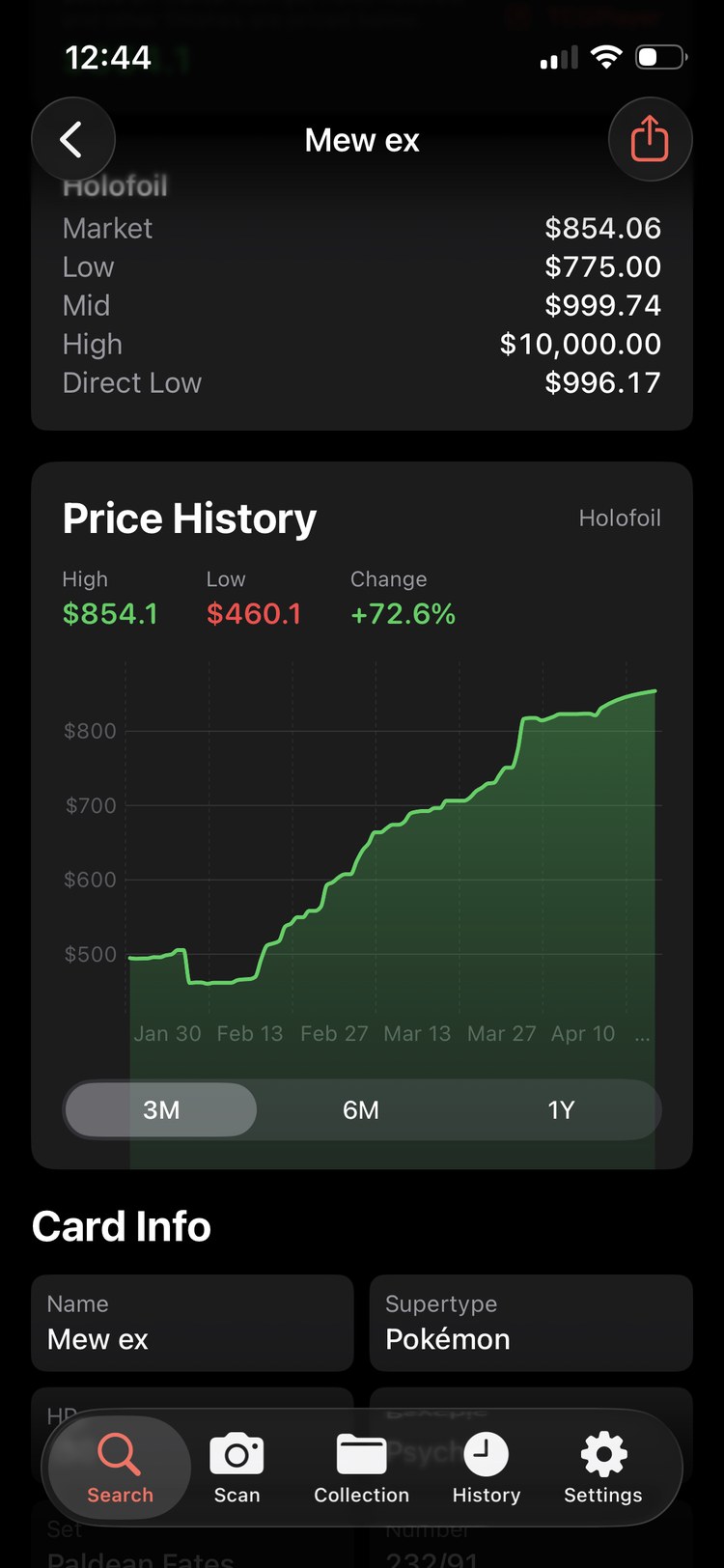
MonZap identifies the exact printing first, then shows available TCGplayer USD and Cardmarket EUR price histories with the marketplace and currency kept visible.
Why scanner apps sometimes disagree
Apps can refresh on different schedules, map variants differently, choose different default conditions, and surface different market metrics.
The fix is not to trust whichever number is higher. Confirm identity first, then inspect the source label, currency, condition, recency, and volume behind each reference.
For a broader comparison of listings, auctions, and graded data, read why Pokémon card apps show different values.
TCGplayer vs Cardmarket FAQ
Quick answers for cross-market Pokémon card comparisons.
Why is Cardmarket cheaper than TCGplayer for some Pokemon cards?
The marketplaces serve different regions with different supply, demand, languages, seller competition, currencies, taxes, and shipping. A lower headline price can also exclude delivery costs or describe a different condition.
Can I compare TCGplayer USD directly with Cardmarket EUR?
Not directly. Convert currency using a current rate, then account for shipping, tax, seller location, condition, language, and whether the values represent sales or active listings.
Is TCGplayer Market Price the same as the lowest listing?
No. Market Price is based on recent completed sales, while the lowest listing is a current asking price for a selected product and condition.
Do TCGplayer and Cardmarket treat holo variants the same way?
Not always. Product mappings and available variants can differ, so verify the exact set, collector number, finish, language, and condition before comparing values.
Does MonZap show both TCGplayer and Cardmarket prices?
MonZap version 1.0.9 shows Cardmarket EUR price-history charts alongside TCGplayer USD references where marketplace data is available.
Primary marketplace references
Marketplace methodology and available metrics can change. Use each platform’s current documentation when a high-value decision depends on the distinction.
- TCGplayer price-point definitionsMarket Price, Listed Median, and listings
- Cardmarket Pokémon marketplaceEuropean offer and price context
- Raw vs PSA Pokémon card valuesGrade-matched comparison guidance
- Holo vs reverse holoFinish identification guidance