The Rarest Pokémon Cards
The most famous rare Pokémon card is the Pikachu Illustrator. Only 39 were officially given out, as prizes in 1998 art contests. A few cards are even rarer. A 1998 Blastoise test print is believed to be one of two, and only 3 World Championships No.1 Trainer cards were made each year from 2004 to 2012.
The Rarest Pokémon Cards, by Copies Known
Most of these were never sold in packs. They were prizes, trophies, or test prints. Counts are per card version, not totals across years. They come from the sources at the end of this page. Where nobody knows the exact number, we say so.
-
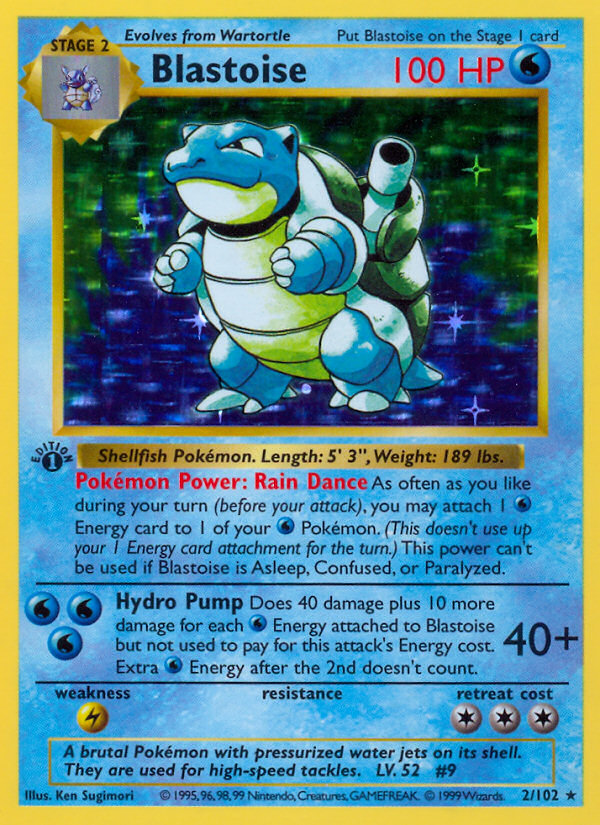
Blastoise Galaxy Star Hologram test print
Card printer Cartamundi made this blank-backed Blastoise so Wizards of the Coast could show what English Pokémon cards would look like. Grading company CGC says a second copy was made for use outside the U.S., and nobody knows where it is now. A CGC 8.5 copy sold for $360,000 at Heritage on January 14, 2021.
2believed made
-
No.1 Trainer, World Championships
The winners of the Pokémon World Championships get a No.1 Trainer card. Only 3 copies of each year's card were made from 2004 to 2012. From 2013 the count rose to 6 a year, when video game champions were added.
3a year, 2004 to 2012
-
Prerelease Raichu
This Raichu was reportedly printed by mistake. Wizards of the Coast denied the card existed until 2006. Wizards estimated about eight copies, and Bulbapedia says eight to ten. A PSA 6 copy, the only one PSA had graded, sold for $555,000 at Heritage in September 2025.
8 to 10thought to exist
-
Trophy Pikachu (No.1, No.2 and No.3 Trainer)
Gold, silver and bronze Pikachu cards went to top players in the qualifying rounds of early Japanese tournaments, not the finals. Bulbapedia estimates about 14 copies of each 1997–98 Mega Battle print and about 9 of each 1999 print. For the very first 1997 tournament print, it can only confirm at least 2 copies. A PSA 10 bronze No.3 Trainer sold for $1,769,000 at Goldin in May 2026.
9 to 14per print, estimated
-
Master's Key
This card went to the finalists of Japan's 2010 World Championship qualifier in Tokyo, in both the card game and the video game. Going by the number of finalists, Bulbapedia counts 36 copies.
36given out
-
Pikachu Illustrator
Winners of three art contests in the kids' magazine CoroCoro Comic each got one. That adds up to 39 official copies. Two more had surfaced by August 2020, so at least 41 are known. The only PSA 10 sold for $16,492,000 at Goldin on February 16, 2026, the most ever paid for a trading card at auction.
39officially given out
-
Ishihara-GX
Guests got this card at a private party for Tsunekazu Ishihara's 60th birthday during the 2018 World Championships in Nashville. He is the president of The Pokémon Company. Nobody knows how many were printed. PSA's own estimate was anywhere from 30 to 200.
30 to 200estimated
Every number above is a count or estimate from the cited source as of November 2026. Old prize cards sometimes turn up, so these counts can change.
Why the Rarest Card Is Not Always the Priciest
A card can be very rare and still sell for less than a more common one. The Blastoise test print has about two copies and sold for $360,000. The Pikachu Illustrator has 39 official copies, yet one sold for $16,492,000.
Price comes from demand as much as supply. Pikachu is the face of Pokémon. The Illustrator also has a great story, and its grade was perfect. Few people know the Blastoise test print exists, so fewer people bid on it.
To see which cards sell for the most, not which are scarcest, read our list of the most expensive Pokémon cards.
How to Read a Pop Count
Sellers love to say a card is "one of 5 graded." That number is useful, but it is not the number of copies that exist.
- It only counts graded cards. PSA's population report lists cards PSA has graded. Raw cards in binders are not in it.
- Each grader keeps its own count. A card graded by CGC or Beckett shows up in their report, not PSA's.
- Some cards get counted twice. PSA asks owners who crack a slab to send the label back. If they don't, the old grade can stay in the count after the card is graded again.
- Counts go up over time. The trophy Pikachu that sold in May 2026 was reported as one of five PSA had graded. As more copies get graded, that number can rise.
To judge how rare your own card is, start with the printed rarity mark and collector number. Our guide on how to tell if a Pokémon card is rare shows what each symbol means.
Rare Cards You Can Still Pull or Buy
Pack cards are printed in huge numbers, so none come close to the cards above. Still, each era has a top rarity tier that is hard to pull. Here is one example of each, with its latest TCGPlayer market price for an ungraded copy.

Flareon ★
Power Keepers · 100 / 108
- TCGPlayer
- $1,700
- Updated
- October 28, 2026

Mew ex
Paldean Fates · 232 / 91
- TCGPlayer
- $834
- Updated
- November 3, 2026

Charizard ex
Obsidian Flames · 228 / 197
- TCGPlayer
- $34.83
- Updated
- November 3, 2026
Official pull rates are not published for English sets, so the odds you see online come from fans opening lots of packs. Browse every card in a tier: Gold Star cards, Special Illustration Rares, Hyper Rares, and Secret Rares.
Questions About Rare Pokémon Cards
What is the rarest Pokémon card?
The most famous rare Pokémon card is the 1998 Pikachu Illustrator. Only 39 were officially given out, as prizes in CoroCoro Comic art contests. By copies alone, a few cards are even rarer. A 1998 Blastoise Galaxy Star test print is believed to be one of two, and only 3 World Championships No.1 Trainer cards were made each year from 2004 to 2012.
How many Pikachu Illustrator cards exist?
39 were officially given out across three CoroCoro Comic contests in 1998. Two more surfaced by August 2020, so at least 41 are known. Only one has been graded PSA 10. It sold for $16,492,000 through Goldin on February 16, 2026.
What is the rarest English Pokémon card?
Among English cards that were actually handed out, the World Championships No.1 Trainer cards are some of the rarest: only 3 were made each year from 2004 to 2012. The Base Set Prerelease Raichu is another, with about 8 to 10 thought to exist. The 1998 Blastoise Galaxy Star test print is believed to be one of two, but it was never released.
Is the rarest Pokémon card also the most expensive?
Not always. Fame and demand matter as much as the number of copies. The Pikachu Illustrator has 39 official copies and holds the record at $16,492,000. The Blastoise Galaxy Star test print is rarer, at about two copies, but sold for $360,000 in 2021.
Does a PSA population report show how many copies exist?
No. It only counts cards PSA has graded. Ungraded copies and cards graded by CGC or Beckett are not in it. A card that is cracked out of its slab and graded again can also be counted twice if the old label is not sent back to PSA.
Sources
- CGC: Blastoise Galaxy Star Hologram auction record (test print, second copy, $360,000 at Heritage, January 14, 2021).
- Bulbapedia: No.1 Trainer and No.3 Trainer (trophy Pikachu awards and copy estimates; World Championships prints, 3 a year from 2004 to 2012 and 6 from 2013).
- StarCityGames, May 2026 (PSA 10 bronze trophy Pikachu, $1,769,000 at Goldin, one of five graded by PSA).
- Bulbapedia: Raichu (Base Set 14) (Prerelease Raichu, about eight to ten copies).
- Heritage Auctions Intelligent Collector, September 2025 (PSA 6 Prerelease Raichu, $555,000).
- Bulbapedia: Master's Key (2010 finalist prize, 36 copies).
- Bulbapedia: Pikachu Illustrator (39 official copies, at least 41 known).
- Guinness World Records: most expensive trading card sold at auction (PSA 10 Pikachu Illustrator, $16,492,000).
- Bulbapedia: Ishihara-GX (2018 private event, PSA's estimate of 30 to 200 printed).
- PSA terms and conditions and PUSHAS: PSA population report explained (returning labels from cracked slabs, double counts).
Find Out What Your Card Is
Scan any Pokémon card to get its exact set, number, rarity and current price with MonZap.
Download MonZap Free